Anything about sewing machines and the tools we use.
  • User avatar
  • User avatar
  • User avatar
  • User avatar
  • User avatar
User avatar
By Cougar
#14335
My 226RB-5 doesn't seem capable of sewing completely in-line straight stiches. It sews stitching that is inconsistent and angled to the right. I have tried different needle points (R, RG, SD) all to no avail. I also just tuned up the machine and all timings are in spec. Still it sews angular stitches. I ran a piece of paper thru the machine and the needle holes line up nicely in both forward and reverse. I also noticed the bobbin side stitches look much straighter than the upper thread. Any ideas?
User avatar
By Cougar
#14345
Hello, I am using a Groz-Beckert size 20 needle with a "R" point and size T92 bonded polyester thread. I am sewing between 2 and 3 layers of cheap vinyl. I have tried a size 18 "R" needle and a size 22 "SD" needle and it seems to do the same thing. I'm stumped.
User avatar
By Mtl_Biker
#14351
@Cougar - My first thought would be that there is uneven feeding of the material... I have had that happen and it could be the weight of the material assembly pulling it away from a straight line, could be that you are not feeding it straight, if it's a small piece maybe the feed dogs are only gripping the fabric on one side.

Is it possible that you could make a small video showing the problem? That would certainly help us help you.
User avatar
By BigRig
#14358
@Cougar, can you double check and make sure the groove of that needle is facing left .
Once thread is in pull that thread taught and look at angle of the thread. I am the king of machine problems mostly all my won doing.
John liked this
User avatar
By Cougar
#14362
@BigRig The needle groove is in the correct position. I am using a #18 and have tried a #20 as well with basically the same results.
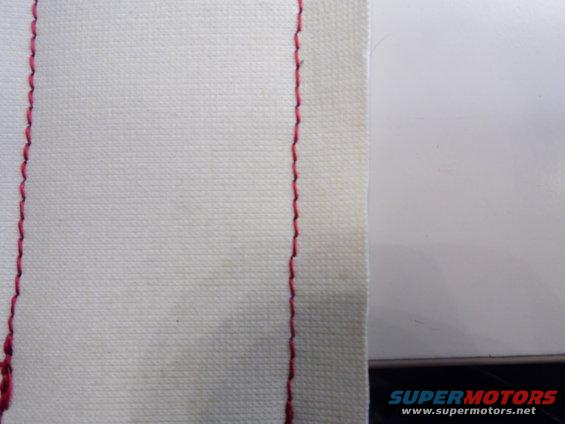
Well, I don't know how to post a video but I'll try a few photos. The first photo is a short line showing the angular stitches. This was sewn with T92 bonded polyester thread and a #18 needle. I have noticed that using a T69 bonded polyester thread shows much less angularity. The second photo is a paper I used for checking different stitch lengths in forward and reverse during my tuneup. It shows the needle holes are staying in-line at least when no thread is used. Hope this helps decipher my issue.

Image

Image
User avatar
By Mtl_Biker
#14364
Cougar wrote: Mon Jan 24, 2022 5:26 pm @Mtl_Biker OK, I made a video of the machine sewing. How do I upload a mp4 video?
The easiest way (might be the only way with a video?) is to have the video hosted somewhere else (I use SmugMug but there are lots of options) and then simply supply a link to it in your message. Maybe @John might jump in to let us know if there is a way to directly upload a small video here.

From the photo you showed later in this thread it does look to me as if the fabric assembly isn't feeding straight. The question is, why?
User avatar
By John
#14426
Hey guys! Sorry I am late to the party here. As you found out this is something that is inherent to the way the stitch is formed. It honestly has never really bothered me much. If you look at top stitches in most cars they are slanted and many people including my self prefer that look. It also helps to hide slight inconsistencies in stitch straightness. On the other hand it really bothers some people.

I reached out to my contact at Groz-Bekert about this and if he knew if their was any way to solve this. This was his advice:

For slanted stitches, you will have a difficult time stopping them if you are using a R point on a single needle machine. However, you can try this trick that we have incorporated into the 134-35 SAN 12 LR and S cutting point needles for the 2 needle machines.. I think I sent a SAN 12 Brochure to you in the needle case. Just in case, I have attached it to this mail.
https://www.groz-beckert.com/mm/media/e ... SAN_12.pdf

Looking in the SAN 12 Brochure, you will see that the 2 needle machine has 2 hooks going in different directions. So on the right needle. we ground a flat on the shank that repositions the needle when you tighten the set screw. Since the loop is forming at a slight angle with normal needles, the SAN 12 LR moves the scarf at a angle that puts the loop straight out for the hook to pick up. This helps make a straight stitch on both side of a joined seam. Same idea on the SAN 12 S, but it requires a flat on both needles. Left and right.

Keep in mind that the thread is also a major factor in the appearance of the set stitch. Eye size on the needle can wind or unwind thread which causes different set stitches.


I have not tried this yet so I dont know what direction the needle needs to be turned but they went through the trouble to make special needles just for this issue. I'm sure with some experimentation you could find the right position to get this to work. I would just be careful to check and make sure that the hook doesn't hit the needle if you rotated it to far.

If any one does some experimenting with this let us know how it works out!

User avatar
By Cougar
#14433
@John Being new to sewing and upholstery work, can I fit and use a 134-35 needle in my Consew 206RB-5 that normally uses a 135x17 needle? I noticed the shank size is the same but the length is a bit shorter (38.1mm vs 38.9mm).
User avatar
By Adam12
#14438
You could use 134/35 but it requires lowering of the needle bar which may or may not cause a clearance issue. Needle bar could contact the foot with feet lifted and needle down.
User avatar
By John
#14444
Adam is correct on that. This is an area I am still have a lot to learn on. I had had this very conversation in the past with my connection at Groz-Beckert. This is what he explained to me.

Through the years, the long needle used in the US was the 135x17 and 135x16 due to all of the technical textiles and leather being sewn here. The rest of the world used 134-35 needles which is identical to the 135x17 and 135x16 in needle geometry. Since most of the leather (shoes) has gone to other countries and the Technical Textiles are larger in other parts of the world, Groz-Beckert has invested in the 134-35 needle system as far as point styles and (SAN) Special Application Needles. We offer many more cutting points and sizes in the 134-35 system.
There is one difference in the 2 needles. Length.
135x17/135x16 - 38.9 mm in length from the top of the shank to the top of the eye. **We never use the entire length of a needle in length dimensions.
134-35 - 38.1 mm in length from the top of the shank to the top of the eye.
Only a 0.8 mm difference.
Many times you can go from the 135x17 to the 134-35 with no problem, depending on how the hook was set. Other times, you will need to lower the needle bar height 0.8 mm or about half the length of the needles eye.


I may consider switching my machines over to 134-35 to have more needle options....
New guy

Perhaps a larger needle? Could be getting deflecte[…]

First Auto Upholstery Project

Thanks, everyone! Yes, that's Morbern Carrara in […]

using Styrofoam

OK Thanks

Stay away from unknown manufactures when it comes […]